In this guide
A municipal announcement contains several kinds of information. Separate the work, the threshold, the selection process and the terms before deciding what to do next.
The announcement is a small evidence system
A job title can create a vivid impression before the actual duties are clear. “Coordinator” may suggest organizing people, yet the work might revolve around reconciling records, preparing a recurring report or arranging service across several locations. A municipal department name adds another impression. The useful question is what the specific position needs someone to accomplish, under which conditions, and what an applicant must demonstrate to be considered.
Phoenix’s public application guidance asks applicants to connect their materials to the job announcement. Its Water Services careers page also emphasizes the minimum qualifications and application instructions. Those points support a careful reading method; they do not make every recruitment identical. This guide proposes an original five-column vacancy ledger: statement, category, evidence, unresolved detail and next action. The ledger is for your preparation, not an official application form.
Begin by recording the job title, job ID, department, posting address and date you read it. Add the closing date exactly as displayed, including any time or time-zone wording. If the announcement describes an ongoing recruitment, do not invent a fixed deadline. A saved copy can explain what you relied on, but it cannot keep an expired posting open or override a later correction.
Column one: what work needs doing?
Read the duties before hunting for attractive benefit language. Turn each major duty into a verb, an object and an outcome. “Maintains records” becomes “keeps specified records accurate enough for the next person to use.” That translation is a prompt to investigate what records, what accuracy standard and which downstream user matter. It is not permission to add responsibilities that the announcement never stated.
Consider a hypothetical office role that mentions scheduling inspections and answering status questions. A weak reading labels it “customer service.” A stronger reading distinguishes intake, schedule coordination, status communication and record accuracy. Each activity may need a different example. Someone who has managed a shared appointment calendar might have relevant evidence for coordination but still need to explain unfamiliar technical vocabulary honestly.
Keep the frequency and consequence of the work separate. A task listed only once may carry major responsibility; a frequently repeated task may be central even if it sounds routine. When those priorities are unclear, write an interview question rather than assign a made-up percentage of the working day. See Where city work happens: comparing Phoenix service settings for a way to connect duties to their operating setting.
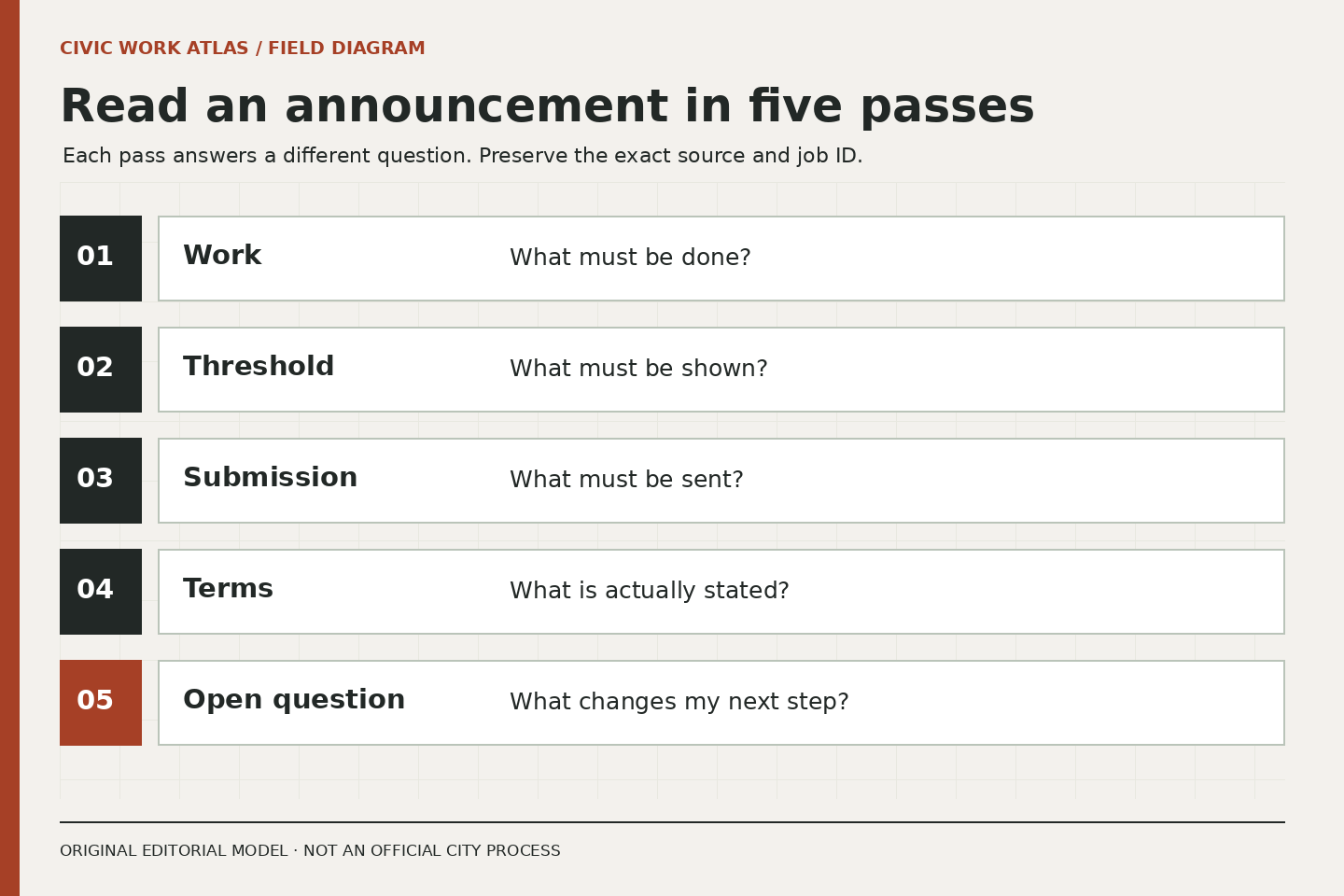
Column two: which conditions are thresholds?
Mark statements that the announcement identifies as minimum qualifications separately from preferences. Preserve words such as “and,” “or,” “equivalent” and any stated timing. A license required by the start date is different from one required when applying. An accepted equivalency in one announcement does not establish equivalency in another. Do not calculate your own exception from a general career page.
For each condition, write a truthful evidence note. Instead of “probably covered,” identify the relevant job dates, completed course, credential or specific responsibility. If your experience was part-time, do not quietly rewrite it as full-time. If two jobs overlapped, preserve the actual dates. The purpose is to make your history legible, not to decide your own official qualification status.
A hypothetical candidate sees a requirement for preparing reports and a preference for a particular software package. Their work shows careful reporting in a different system. They should describe that experience accurately and distinguish it from experience they do not have. The preference might still matter competitively. Calling it optional does not mean it is irrelevant, and calling the systems similar does not make them the same.
Column three: how will the evidence be submitted?
Application mechanics deserve their own reading pass. Record requested documents, questions, file instructions and any stated assessment stages. Phoenix’s general page includes a recommendation about combining a cover letter and resume; an individual announcement may add role-specific instructions. Resolve the exact current request before preparing the final file. Do not rely on an old screenshot or an instruction from a different employer.
Build a submission checklist from the announcement rather than from a generic career template. A useful item is observable: “The uploaded file opens and contains the intended pages.” “My application is strong” cannot be checked in the same way. Keep a local copy of what you submitted and any ordinary confirmation, without copying private account information into this publication or a public document.
An eligible-for-hire list, interview invitation and job offer are different stages. Do not interpret a submission receipt as advancement or a list placement as a promise of selection. If the current announcement explains how updates are delivered, retain that instruction. If it does not, use the official recruitment contact rather than inventing a timetable from someone else’s experience.
Column four: what are the actual terms?
Capture any stated location, work pattern, travel, equipment, physical demands and compensation information. Keep exact wording when an important distinction would disappear in a summary. A broad pay range is not necessarily the hiring range. A department may have many sites; its headquarters address does not prove the reporting location for this role. “May” is not a confirmed arrangement.
For a hypothetical comparison, Vacancy A states a worksite and recurring shift while Vacancy B describes possible assignments at several facilities. That is a difference in certainty, not automatically a reason to reject B. The ledger should mark the unanswered location question and explain why it matters to your decision. Ask for the applicable arrangement at the appropriate recruitment stage.
Benefits need a reference field rather than a copied marketing paragraph. Record the linked guide, employee category and period if stated. A general overview may introduce what to investigate without establishing your eligibility. Build a Reliable Picture of Public-Sector Compensation explains how to keep these source layers apart so a number from one document does not silently become a promise in another.
Column five: what changes your next action?
Give every unresolved question a consequence. If a missing detail affects whether you can complete the application correctly, it belongs near the top. If it is useful background but does not affect submission, it can wait. This prevents a large research file from becoming a substitute for reading the actual instructions and meeting a known deadline.
A practical final review has three passes. First, check factual accuracy: titles, dates, duties and qualifications reflect your real history. Second, check compliance with the announcement’s requested format and information. Third, check interpretation: remove any claim that the City has already accepted a qualification, agreed to a schedule or promised a starting rate when it has not.
The finished ledger should let you explain the opportunity in a few plain sentences: the service the role supports, two important duties, the evidence you can supply, the application requirements and the largest unanswered term. That is a stronger basis for action than either enthusiasm or caution alone. The next useful document is often a short evidence map, developed in Translate Experience into Municipal Application Evidence, rather than another broad list of career tips.
Related reading: Translate Experience into Municipal Application Evidence, What a Classification Tells You, and What a Vacancy Adds, Build a Reliable Picture of Public-Sector Compensation.