In this guide
Make relevant work visible through accurate dates, specific responsibilities and explainable outcomes, without borrowing duties or disclosing confidential records.
Build from the requirement, not the adjective
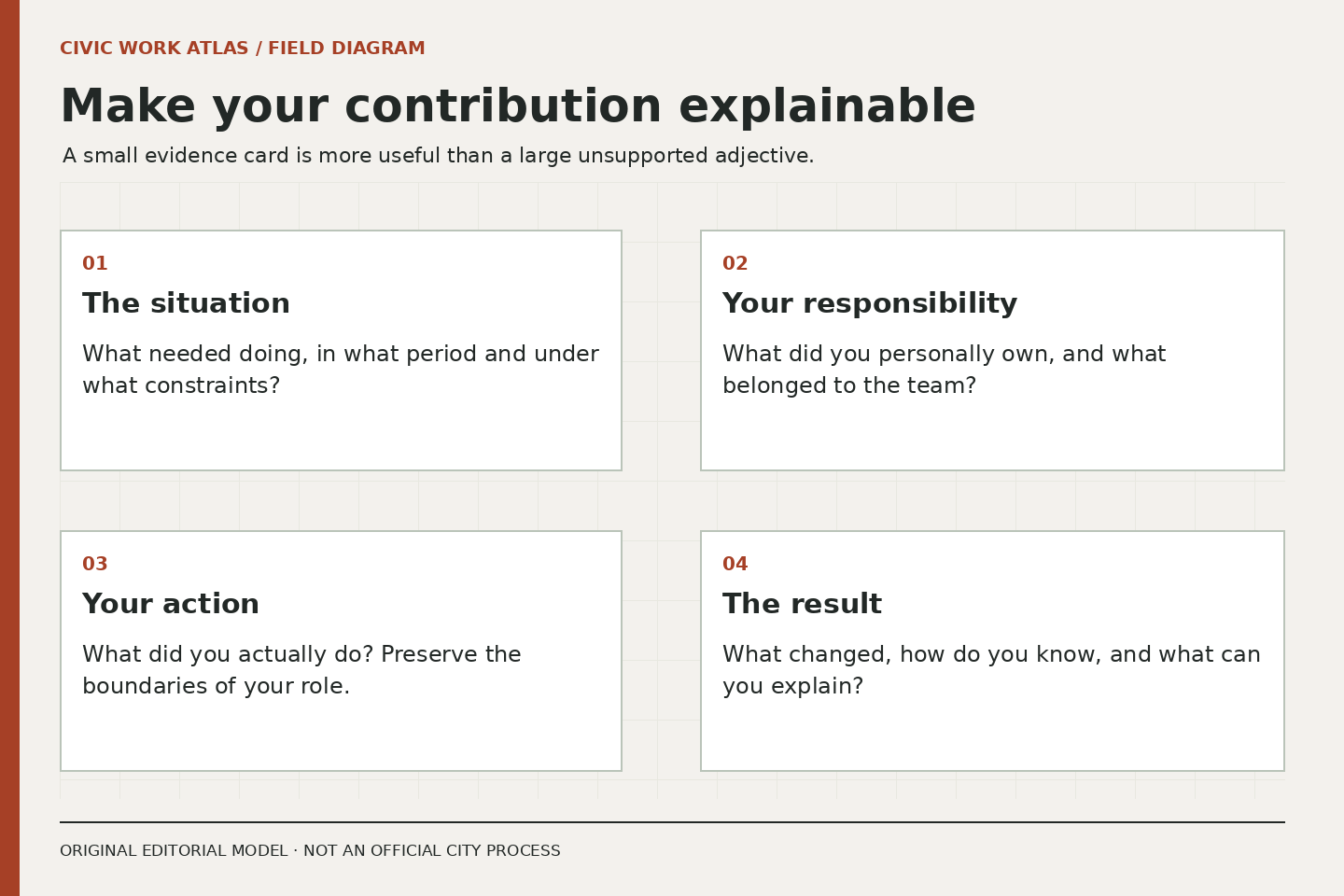
“Organized,” “reliable” and “good with people” can describe a candidate’s intention without showing what they have done. Start instead with a duty or qualification in the exact announcement. Under it, write a work example that another person could understand: the situation, your responsibility, your action and the observable result. This is an editorial preparation method, not a City scoring rubric.
Phoenix’s public application guidance emphasizes the information supplied in application materials. That makes omission a practical problem. A reviewer cannot evaluate relevant work that exists only in your memory. Equally, filling the gap with a duty you never performed creates a worse problem. The aim is specific, truthful visibility.
Use an evidence card
Prepare one small card for each substantial example. Give it a plain-language title, the period of work, your actual role, the task, the constraints and the outcome. Add the announcement requirement it might support. Keep supporting records in an appropriate private location; the card itself should not contain customer details, employee records or confidential operational information.
In a hypothetical example, a candidate helped reconcile duplicate requests in a shared queue. Their card explains how they identified duplicates, checked the relevant references and left a clear status note for colleagues. “Improved operations” is too broad unless the candidate can explain how. A narrower statement about preventing the same request from being handled twice may be more accurate and more persuasive.
Separate your contribution from the team’s result. If three people redesigned a process, describe the part you owned and the work you shared. Do not promote assistance into sole leadership. Collaboration itself can be useful evidence when the account makes responsibilities clear.
Dates make experience interpretable
Record month and year accurately, and distinguish employment, volunteering, training and personal projects. Phoenix’s general guidance requests chronological detail. A relevant older example may still matter, but the current announcement determines what information is needed. Do not erase earlier experience merely to fit an arbitrary one-page rule if that would hide the evidence being requested.
For overlapping roles, preserve the overlap. For a gap, do not create an invented project. For unfinished education or training, use wording that makes its status clear. A reader should not need to guess whether a credential was completed, a course was attended or a skill was learned through practical work.
Choose outcomes you can explain
Numbers help only when they are real and meaningful. If you know the number of requests handled and the relevant time period, state both. If you cannot verify a percentage improvement, do not manufacture one to make the bullet look stronger. A concrete qualitative outcome, such as producing a complete handover that another shift could use, can still communicate useful work.
An original test is to ask three follow-up questions of every claim: What did you personally do? How do you know the result? What would a colleague recognize about this description? A claim that collapses under those questions needs narrowing. This self-check also prepares you for an interview without turning your answer into a memorized performance.
Adapt the material without changing the history
Two vacancies may call for different selections from the same truthful history. An administrative role may make your record accuracy example central; a public-facing role may make the explanation you gave to a frustrated customer more relevant. Tailoring means choosing and explaining evidence for the present question. It does not mean relabeling your former position to resemble the advertised title.
Before submission, compare the final material to the actual announcement again. Check required documents and instructions, then open the file as a reader would. Look for missing pages, accidental tracked comments, unreadable formatting and material intended for another application. Keep the ordinary submission confirmation if one is provided.
Keep the boundary around private information
A work sample is not automatically yours to disclose because you helped create it. Prefer an original fictional reconstruction that demonstrates the method without copying employer data, and label it clearly as a sample. Follow the application’s actual requests; unsolicited attachments can add risk and distract from the required evidence.
The finished application should leave a reader with an accurate account of your preparation and contribution. It cannot guarantee advancement. Use Read a City Vacancy as a Set of Evidence Questions to check fit with the announcement and Prepare an Interview around Service, Judgment and Evidence to turn the same evidence cards into concise, explainable interview examples.
Related reading: Prepare an Interview around Service, Judgment and Evidence, Read a City Vacancy as a Set of Evidence Questions, Keep Personal Work Evidence without Copying Official Records.