In this guide
- A workplace is more than its address
- Resident service points: a short encounter with a long chain behind it
- Parks and community spaces: participation and upkeep meet
- Streets and mobile operations: the work moves with the asset
- Plants, shops, and facilities: continuity can be the central outcome
- Administrative centers: distance from the public does not remove service responsibility
- Technology settings: one support function, many service dependencies
- Make the comparison observable
- Sources and scope
A setting-by-setting guide to the pace, handoffs and questions that matter when choosing municipal work.
A workplace is more than its address
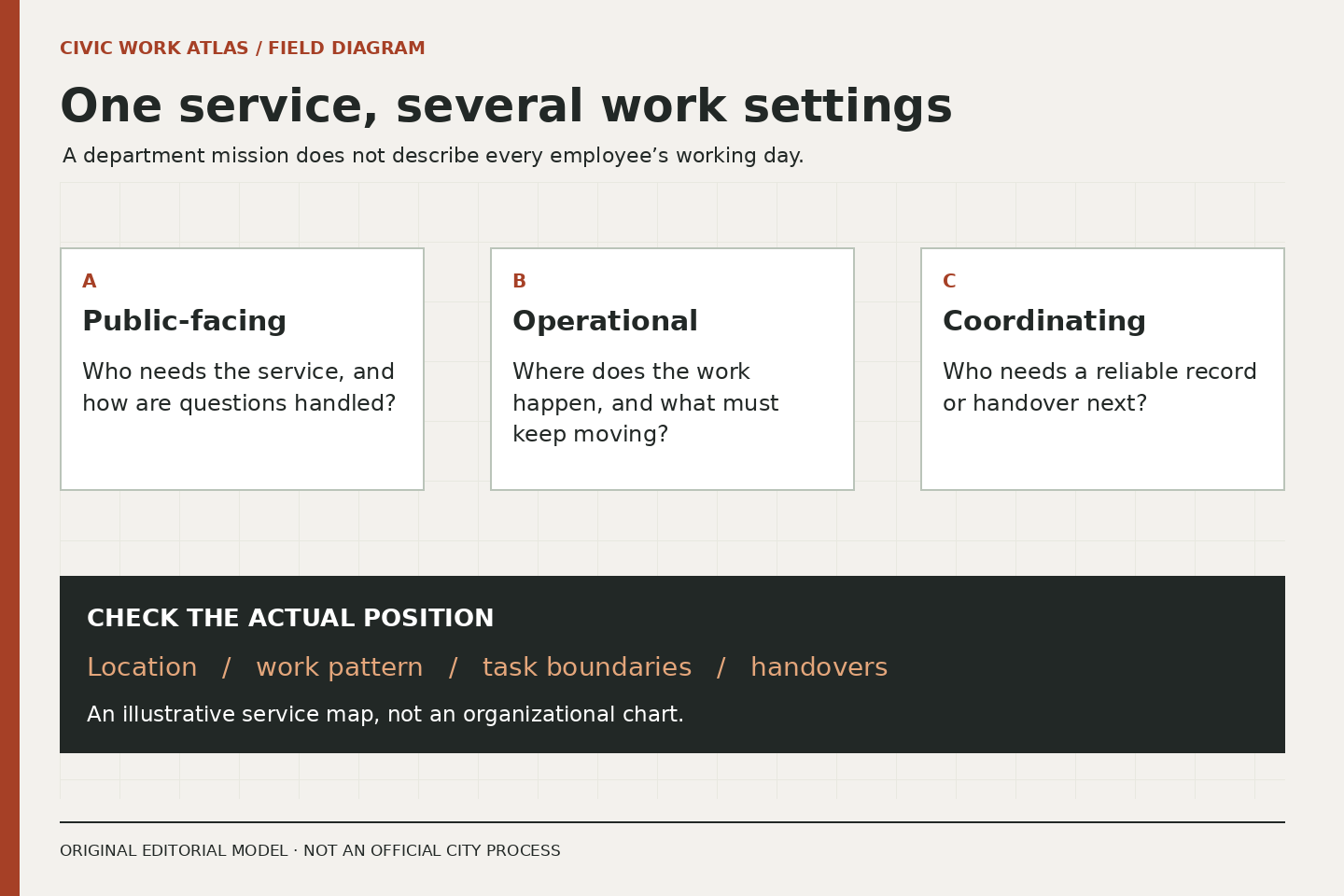
The setting of a job changes how skills are used. Explaining a process at a busy counter is different from explaining it in a scheduled workshop. Diagnosing an equipment problem in a controlled work area is different from coordinating a response across several sites. A position that looks office-based may depend on field information, while a field assignment may require substantial records and communication. Comparing settings helps a reader avoid choosing a role from its title alone.
Civic Work Atlas uses five questions to make that comparison: what starts the work, how predictable is the sequence, who needs the result, what makes interruption consequential, and what must be documented afterward? These questions are an editorial framework, not an account of a particular Phoenix employee's day. The examples below are hypothetical. Actual schedules, locations, travel, physical requirements, supervision, and working arrangements belong to the individual recruitment and should be confirmed there.
Resident service points: a short encounter with a long chain behind it
At a public service point, the immediate task may be a question, a request, a registration, or a document that needs routing. The encounter is visible, but its quality also depends on the less visible steps around it: identifying the right process, capturing information accurately, recognizing the limits of the employee's authority, and leaving a record another person can use. Readers drawn to public contact should consider whether they enjoy this combination of conversation and procedural care.
A hypothetical resident asks why a request has not progressed. An effective response would distinguish what the employee can verify from what requires another team's review. The work sample to imagine is not a persuasive speech promising resolution. It is a concise explanation of the known status, the next responsible office, and the information needed to move forward. If this type of structured assistance feels satisfying, examine public-facing announcements closely. If constant interruption is a concern, ask about workload distribution rather than assuming all service roles have the same pace.
Parks and community spaces: participation and upkeep meet
Phoenix's Parks and Recreation materials describe a service world that includes parks, programs, and partnerships. The City's department directory also points to hiking trails, classes, sports leagues, golf, and pools. That variety is a reason to inspect the assignment carefully. Working around a community activity can involve direct participant support, program preparation, facilities work, or coordination. Enjoying a place as a visitor does not by itself tell you which of these contributions you would enjoy as an employee.
Imagine preparations for a community class. Someone needs a usable room, someone needs accurate registration information, and someone needs the materials and instructions for the activity. If a facility problem occurs, the response may cross several work families. Compare which part of that chain you prefer: facilitating participation, keeping a space ready, or organizing the moving pieces. Do not infer a seasonal or evening schedule merely from the department name; record the actual conditions stated in the announcement and ask about anything material that remains unclear.
Streets and mobile operations: the work moves with the asset
Phoenix Street Transportation identifies divisions covering maintenance, traffic services, design and construction management, management services, and development and utility services. This official structure is a useful reminder that a transportation department contains more than road crews. The public-facing asset is the street network, but the work around it can include planning, coordination, technical review, records, and support. A reader interested in infrastructure should decide whether the strongest attraction is to a physical task, a diagnostic problem, or a project that unfolds over time.
For a hypothetical issue reported at an intersection, imagine the information needed before anyone acts: a precise location, an observable condition, the appropriate responsible team, and a record of what happens next. The exercise is not instruction for conducting traffic work. It is a way to see the importance of location-specific information and handoffs. A role connected to mobile operations may require a different tolerance for changing priorities from a role with a recurring desk queue. Verify conditions rather than guessing from the presence of a vehicle in a recruitment photograph.
Plants, shops, and facilities: continuity can be the central outcome
The Public Works careers page identifies common recruiting areas including solid waste collection, vehicle maintenance, HVAC, plumbing, and electrical work. Water Services has its own careers information. These pages can lead readers toward different operational environments, but they do not make every trade role interchangeable. Maintaining a vehicle, operating a treatment process, and coordinating a building repair involve different assets, training, responsibilities, and consequences. Begin with the system that interests you and then inspect the specific occupation.
For national context, BLS describes water and wastewater operations as work involving machinery, monitoring, testing, and operational records. It also notes that treatment plants operate continuously and that rotating shifts are common in the occupation. Those statements are national occupational context, not confirmation of a Phoenix vacancy's roster. The practical question is how a candidate would learn and communicate a system's status across a handoff. Someone who enjoys disciplined observation may value this work even when success looks like a service continuing without an obvious incident.
Administrative centers: distance from the public does not remove service responsibility
Phoenix Finance describes functions including accounting, procurement, treasury, risk and inventory management, tax and licensing, and real property. These are distinct areas of work, yet they share a useful feature for comparison: other people depend on reliable information and transactions. An office setting can therefore have an indirect but important relationship to the quality of a public service. The meaningful output may be a corrected record, a supported purchase, a complete report, or a clearly documented next step.
Consider a hypothetical replacement-part request. A field team understands the equipment need, while administrative colleagues may need a complete description, appropriate documentation, and confirmation of the applicable process. An applicant who enjoys resolving missing information could find this coordination engaging. Someone primarily seeking uninterrupted individual work should ask about meetings, requests, and service deadlines rather than treating office work as automatically quiet. Explore Administrative city work: the value is in the handoff for a method centered on the quality of the handoff and the evidence left behind.
Technology settings: one support function, many service dependencies
The Phoenix Information Technology Services overview describes enterprise infrastructure, cybersecurity, public-safety radio, applications, databases, and employee support. That scope makes technology a particularly useful example of why setting matters. A user-support assignment, a network role, and an application project can all serve the same organization while requiring different patterns of attention. The visible device or software is only one part of the question; the other is who is relying on it and what they need to do.
Imagine a service team unable to access a routine application. A support specialist may need to establish the scope of the problem, communicate clearly, preserve a usable incident record, and involve the correct technical owner. An application analyst might instead be improving a recurring workflow after the immediate issue is resolved. These are illustrative scenarios, not claims about Phoenix's incident procedures. Compare the appeal of restoring a service, improving its design, or helping people use it effectively. The distinctions are developed further in Technology city work: start with the service dependency.
Make the comparison observable
Write a short setting profile for each serious option. Include confirmed location, the likely sources of incoming work based on the duties, key collaborators, information to document, and questions about schedule or working conditions. Label an inference explicitly. A statement such as likely to receive frequent requests is not equivalent to a published workload expectation. Asking a precise question is more useful than building a personal plan on a stereotype about government office hours or the pace of a particular department.
Then test two options against one ordinary complication: missing information, an unavailable resource, or an unexpected change in priority. Which type of response would you rather learn to perform well? This exercise does not predict hiring success; it clarifies your interest before investing in an application. Return to A practical map of municipal roles in Phoenix to connect the preferred setting to an occupation and its requirements. Official sources were checked October 1, 2026. Unless a source note states otherwise, that date describes this publication's review rather than the source's original publication. The prompts in Read a Municipal Work Schedule across the Whole Cycle can help turn an unresolved condition into a precise recruitment question.
Related reading: Read a Municipal Work Schedule across the Whole Cycle, Administrative city work: the value is in the handoff, Read a City Vacancy as a Set of Evidence Questions.