In this guide
- The job title is only the first coordinate
- Begin with the service, not the department label
- Compare work families by their main output
- Separate a classification from a vacancy
- Read responsibility through decisions and handoffs
- Translate experience into evidence without stretching it
- Use national occupation research as a second lens
- Build a shortlist that leads to a decision
- Sources and scope
Start with the public service being delivered, then compare the work, responsibility and evidence behind a job title.
The job title is only the first coordinate
A search for city work can look deceptively simple: enter a familiar title, sort the results, and decide whether to apply. The difficulty is that a title describes only part of a role. An administrative position attached to a maintenance operation may involve very different interruptions and knowledge from a similarly named position in a public information office. A technology role may support employee devices, a specialized operational system, or the information a resident needs to complete a task. The useful question is what the employee helps the service accomplish.
This guide uses a three-coordinate map: service, responsibility, and evidence. Service identifies who benefits and what must keep working. Responsibility identifies what the employee actually does and where their authority ends. Evidence identifies what an applicant can truthfully demonstrate. Together these coordinates produce a more useful shortlist than a ranking of impressive-sounding titles. The method is an editorial tool from Civic Work Atlas, an independent publication, and does not represent Phoenix hiring policy or an endorsement by the City.
Begin with the service, not the department label
Phoenix's official department directory is a sensible starting point because it separates functions such as Human Services, Housing, Neighborhood Services, Parks and Recreation, Information Technology, and Law. Those labels help explain the organization, but they should not become assumptions about every employee within it. A department delivering a visible public service also needs people who maintain equipment, manage information, coordinate work, and account for resources. Begin by writing one sentence about the service outcome you find meaningful, then look for the occupations that contribute to it.
For example, someone interested in usable neighborhood facilities might initially search only for recreation work. A broader service map would also consider the people who maintain facilities, schedule activities, process registrations, manage supplies, or support the software used by staff. These are illustrative connections, not a list of current vacancies. The point is to identify several plausible routes into the same service mission without pretending that enthusiasm substitutes for the distinct qualifications of each route.
Compare work families by their main output
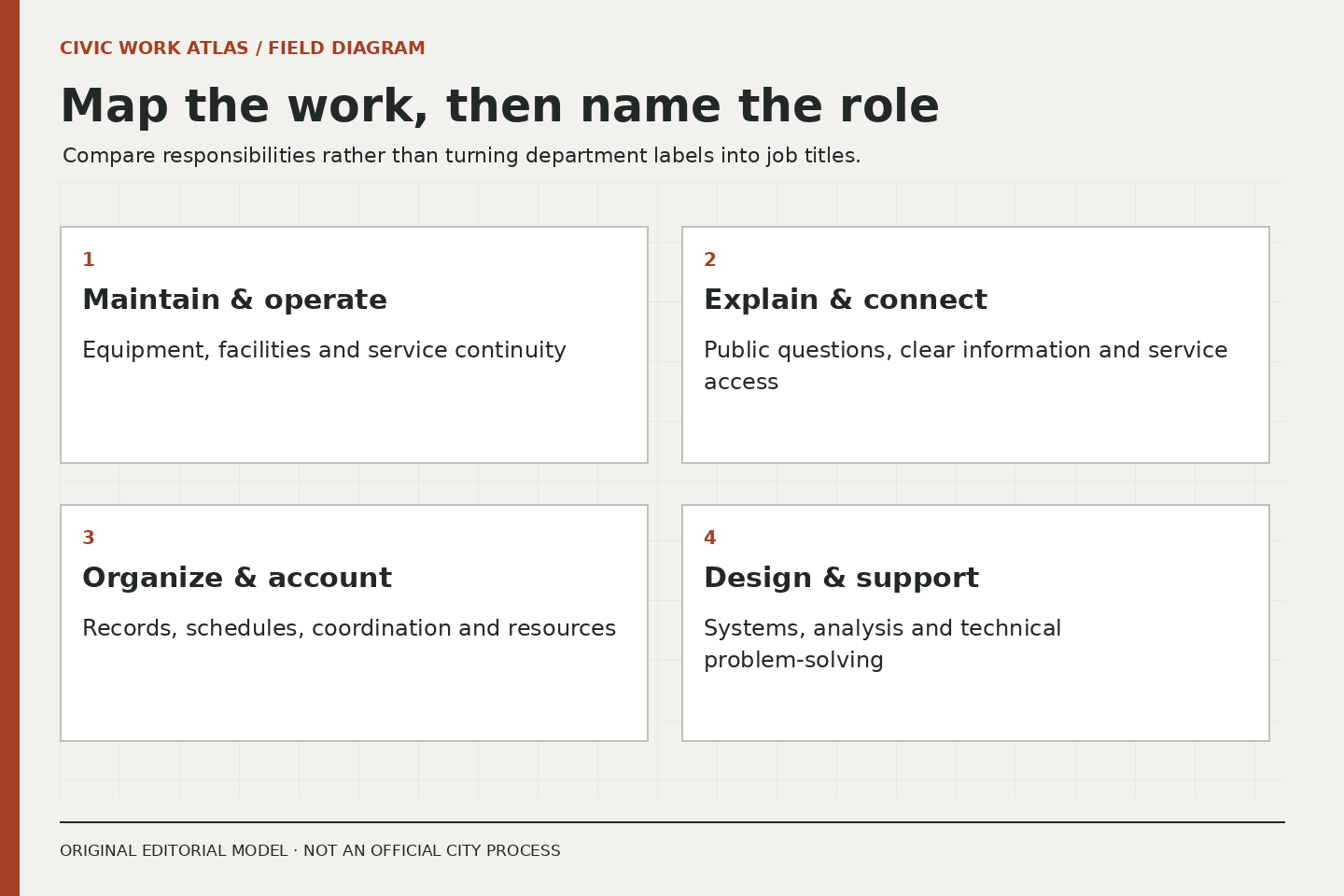
For exploration, divide roles into work families according to their main output. Operational roles keep an asset or process functioning. Public-facing roles help a person navigate a service or participate in a program. Administrative roles make transactions, records, and coordination dependable. Technical roles diagnose, design, configure, analyze, or maintain specialized systems. Professional and regulatory roles apply defined expertise or standards. Supervisory roles coordinate other people's work and take responsibility for resources and decisions. These are reading categories, not official Phoenix classifications.
A role can span several families. Consider a hypothetical facilities coordinator who receives a problem report, creates a work order, checks whether access is available, and informs the requesting office. The primary output may be coordinated work rather than the repair itself. Calling the job simply hands-on or office-based would hide that distinction. When you read an announcement, underline its action verbs and write the result beside each one: inspected equipment, resolved request, reconciled account, completed analysis, or documented decision.
Separate a classification from a vacancy
Phoenix publishes an official Job Descriptions and Pay Ranges library. It is useful for learning the City's title vocabulary and comparing the general scope of classifications. A classification page is not proof that the City is currently recruiting for that title, and a listed range is not an individual offer. Use the library for orientation, then move to the current announcement for the actual department, recruitment dates, minimum qualifications, preferred qualifications, and application instructions. Keep both records when they answer different questions.
Suppose a person finds a classification whose broad tasks resemble work they have done. They should still ask whether the current vacancy needs a particular license, specialized system, supervisory background, or assignment-specific experience. Conversely, an unfamiliar classification title should not be discarded before reading its duties. The practical move is to maintain two columns: general occupation fit and this recruitment's requirements. A strong entry in the first column cannot silently fill a gap in the second. For a closer reading method, use What a Classification Tells You, and What a Vacancy Adds and Read a City Vacancy as a Set of Evidence Questions.
Read responsibility through decisions and handoffs
Responsibility is easier to understand when expressed as decisions. Does the role gather information, recommend an option, approve a transaction, perform a technical action, or supervise the people doing it? Those verbs should not be treated as interchangeable. An employee may explain a process without having authority to waive it. A technician may document a defect without authorizing every repair. A coordinator may assemble a report without deciding the policy it informs. Look for where work is reviewed and where exceptions are escalated.
One helpful exercise is to draw a short handoff chain for a hypothetical problem: request received, facts checked, action assigned, result recorded, requester informed. Place the prospective role at the relevant step or steps. Then ask what information must arrive accurately and what information must leave clearly. This approach often reveals a role's real appeal. Someone who enjoys careful investigation might prefer the checking stage, while someone who enjoys maintaining momentum might prefer coordination across the whole chain.
Translate experience into evidence without stretching it
After identifying a work family, list specific examples from employment, education, training, or volunteer work. Focus on actions and conditions rather than adjectives. Reliable is a conclusion; maintaining an accurate inventory through weekly reconciliations is evidence. Good with people is broad; explaining a multi-step procedure to someone unfamiliar with it is concrete. Never invent quantities or imply authority you did not hold. If an accomplishment belonged to a team, identify your part and describe the shared outcome accurately.
Imagine an applicant from retail comparing customer-service and account-support roles. For the first, a relevant example might involve listening to a complaint, checking the facts, explaining an available resolution, and documenting the exchange. For the second, the stronger example might involve identifying a discrepancy between transactions and a closing record. The same previous job can support different applications, but each version should select different truthful evidence. The goal is clarity for the reader, not adding municipal terminology to unrelated work.
Use national occupation research as a second lens
The U.S. Bureau of Labor Statistics describes information clerks as workers who handle records, collect information, and assist customers. Its Occupational Outlook Handbook is helpful when a reader wants to understand an occupation beyond one employer. That national description does not establish the requirements of a Phoenix vacancy. Likewise, national employment projections cannot tell a reader whether a particular City department will recruit, how many applicants it will consider, or what an individual will earn.
Use the national and local sources in sequence. The occupation profile helps generate questions about the kind of work. Phoenix's classification and vacancy materials answer employer-specific questions. If the sources seem different, do not average them into a new rule. Identify what each source measures. A typical educational route across the country and a stated minimum for one recruitment can both be accurate because they answer different questions.
Build a shortlist that leads to a decision
A useful shortlist needs only a few fields: service outcome, title, main output, confirmed requirements, evidence you possess, unresolved questions, and next action. Mark an unknown as unknown. Avoid assigning a precise fit score when the most important condition has not been checked. A hypothetical applicant might keep one role that appears immediately suitable, one that needs clarification about equivalent experience, and one longer-term path that requires additional preparation. This is a planning distinction rather than an eligibility judgment.
Continue with Where city work happens: comparing Phoenix service settings to compare environments, or use Infrastructure careers: follow the asset through its life, Public-facing city careers: turn a question into a clear next step, Administrative city work: the value is in the handoff, and Technology city work: start with the service dependency for deeper work-family comparisons. Readers exploring their first municipal role can start with Entering city work early in your career: choose the right route. Before acting, return to the official vacancy and verify that it remains open. This article's sources were checked on October 1, 2026; that is our review date, not a claim that every linked source was published that day.
Use the Comparison Desk to compare two role or resource questions.
Related reading: Infrastructure careers: follow the asset through its life, Public-facing city careers: turn a question into a clear next step, What a Classification Tells You, and What a Vacancy Adds.