In this guide
Choose a bounded skill, an appropriate practice activity and a way to observe improvement without confusing course completion with qualification or advancement.
Name a skill small enough to observe
“Learn municipal work” is an understandable ambition but too broad for a useful next step. Choose something you can describe and review: writing a clear status note, checking a set of records consistently, explaining a public process accurately or understanding the vocabulary of a particular occupation. The skill should connect to actual work you are researching.
A learning plan is not a promise of hiring, promotion, licensing or permission to perform a task. National occupation profiles can explain common preparation patterns, while a current vacancy or regulator may set requirements that a personal plan cannot replace. Keep those questions outside the plan until the proper authority answers them.
Separate knowledge, practice and authorization
Knowing how a task is described is different from practicing it, and practice is different from being authorized to perform it in a workplace. The distinction matters especially in technical and safety-sensitive occupations. This publication provides no operating instructions for equipment, treatment processes or emergency response.
An original hypothetical example concerns report writing. A learner can create a fictional dataset and practice making a concise summary. They can ask for feedback on clarity without using employer records. That exercise may improve a skill, but it does not demonstrate that they are authorized to handle a City database or meet every requirement of an analyst role.
Choose a practice artifact
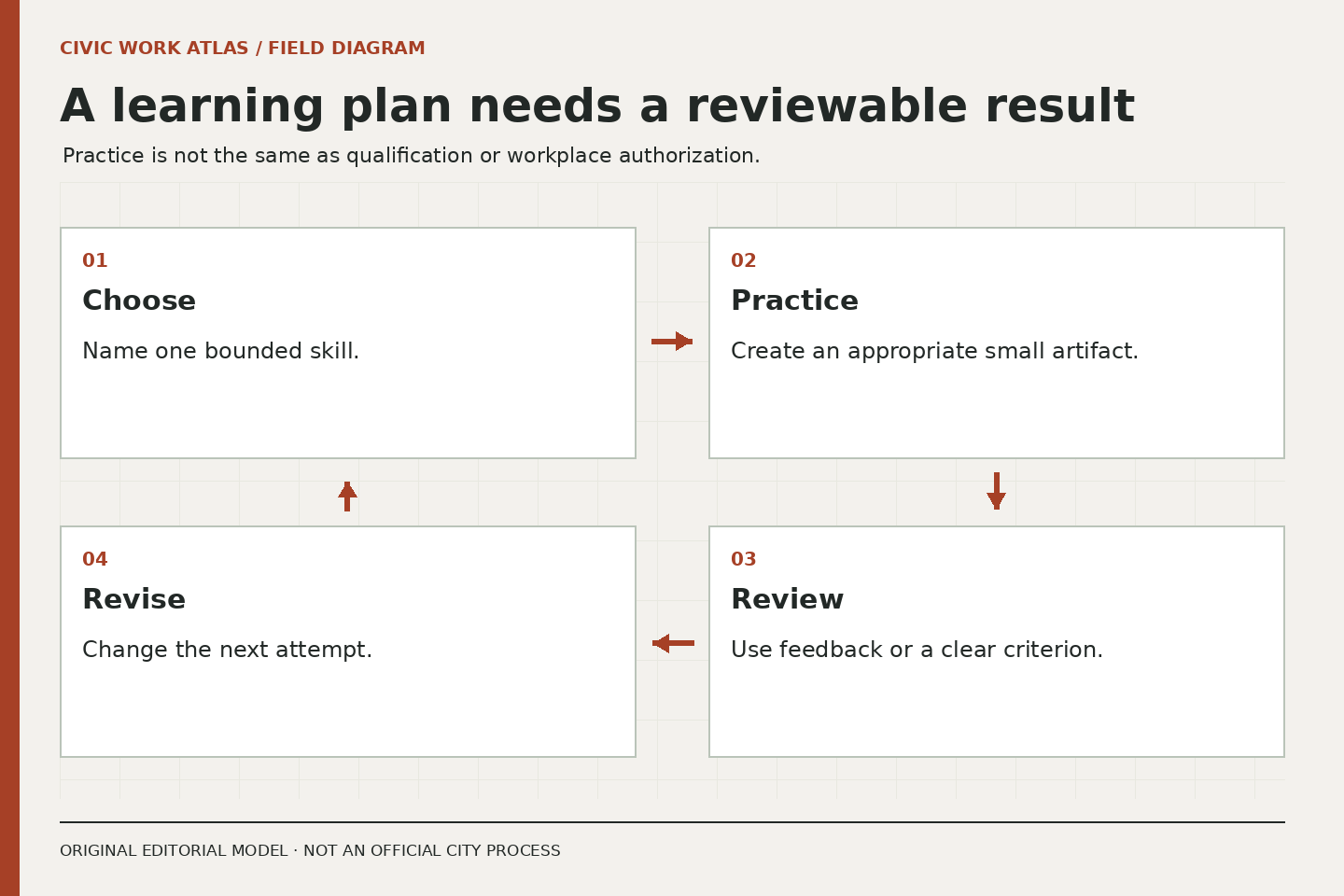
A useful artifact is small enough to review: a sample status note, a clearly labeled fictional worksheet, a comparison of two public documents or a short explanation of a service. State what the artifact is meant to demonstrate. Avoid a portfolio that collects large amounts of material without a question for the reviewer.
For each artifact, identify one quality standard. A status note might be judged by whether the next reader can identify what happened and what remains open. A source comparison might be judged by whether the year, audience and limits stay visible. The standard should be specific enough that feedback can change the next attempt.
Plan feedback before collecting courses
A course can be useful, but completion alone may not show that the skill has improved. Decide how you will test understanding or seek appropriate feedback. That might be a practice exercise, a review against published criteria or a conversation with someone authorized to advise you. Do not invent a certification from an informal exercise.
Use a short review interval that fits the activity rather than a grand annual promise. At the review, ask what became easier, what error still recurs and what evidence supports the answer. If the activity produced no useful feedback, change the activity before simply increasing the hours spent on it.
Keep work learning within workplace boundaries
If you are already employed, follow the employer’s instructions, permissions and supervision. A personal development goal does not authorize access to records, testing on live systems or taking on restricted duties. Discuss the appropriate learning route with the relevant supervisor or training contact.
For a prospective applicant, public sources can help identify questions about required preparation. They cannot settle whether a particular course, outside credential or experience is accepted for a role. Use the exact vacancy and official requirements to investigate that issue separately.
Record progress without overclaiming
A useful learning record states the activity, date, feedback and next revision. “Created and revised a fictional request-tracking example after feedback on clarity” is specific. “Qualified to manage City operations” would be an unsupported leap. The record should make the boundary between practice and demonstrated professional responsibility unmistakable.
The result is a small, repeatable learning cycle: choose, practice, review and revise. Translate Experience into Municipal Application Evidence explains how truthful experience can later support an application. Use the First Month to Build a Reliable Question Map applies the same habit to questions and learning during a new role, subject to the employer’s actual instructions.
Related reading: Entering city work early in your career: choose the right route, Translate Experience into Municipal Application Evidence, Use the First Month to Build a Reliable Question Map.