In this guide
A start time is only one part of a work pattern. Ask about location, repetition, handovers and variability before comparing practical arrangements.
A schedule is a pattern, not one line
A vacancy may describe a shift, a reporting location or availability expectations in a short paragraph. That paragraph can leave practical questions unanswered without being misleading. The reader’s task is to distinguish what is stated from what they have imagined. Do not turn a department’s public opening hours into an employee’s schedule.
Use a blank cycle rather than a single day. The cycle might be a week, a rotation or another pattern described by the employer. Mark confirmed work periods, reporting locations and transitions. Leave uncertain pieces labeled as questions. This is a personal comparison method, not a scheduling entitlement or a prediction of how a City team operates.
Separate four kinds of time
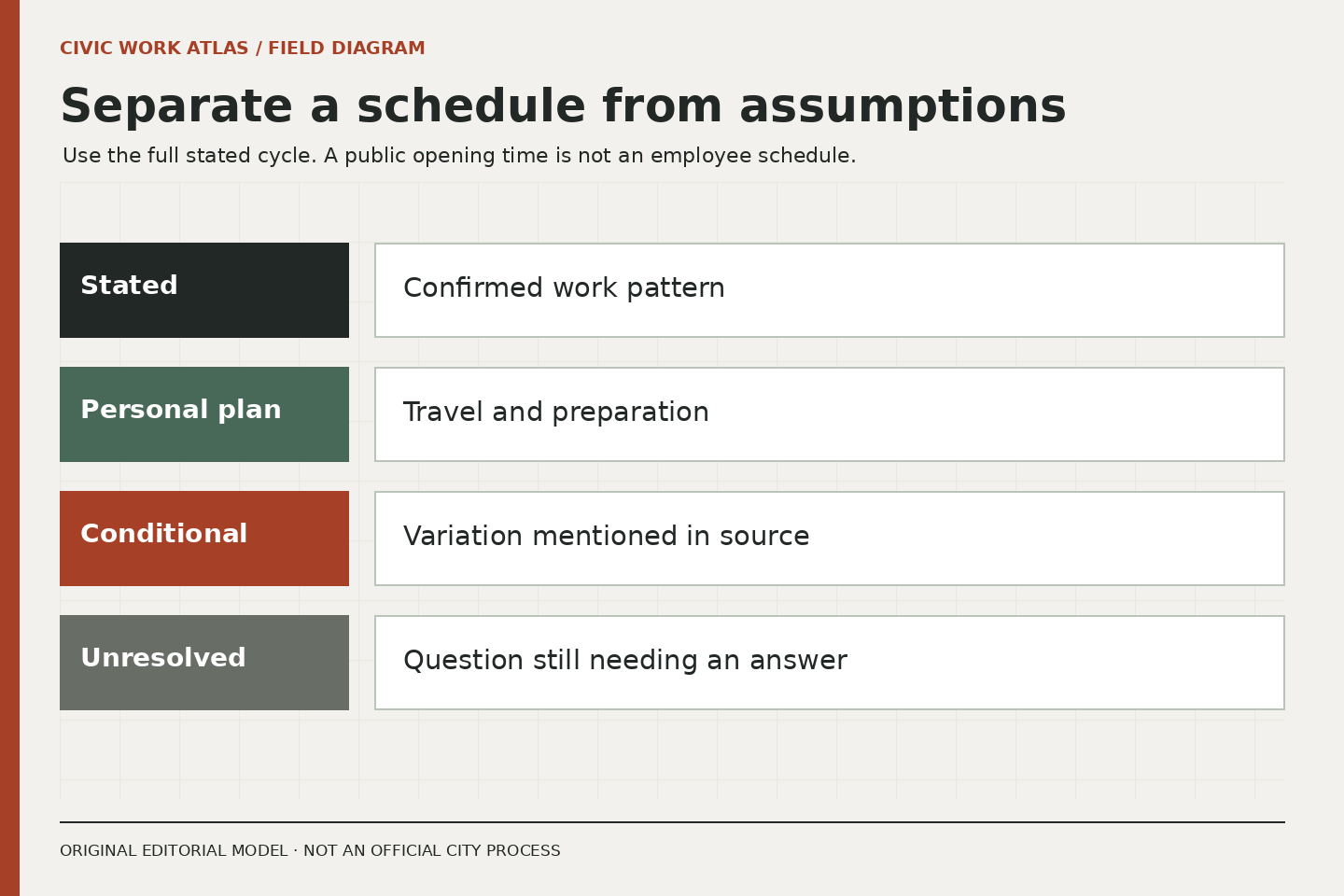
The first kind is the stated work period. The second is travel or preparation you need to plan personally. The third is a possible variation mentioned in the announcement, such as a different assignment or schedule. The fourth is an unresolved condition. Keeping these separate prevents a hypothetical variation from looking confirmed.
Imagine one role with a clearly stated early start at a fixed facility and another with a stated range of possible locations. The first offers more location certainty in the announcement; the second requires another question. Neither fact alone proves which arrangement is better for a particular person. A useful comparison explains the tradeoff without choosing on the reader’s behalf.
Ask about handovers and continuity
Some work is organized around individual tasks; other work needs continuity across teams or periods. Ask what information a new employee needs to receive and leave behind, using the responsibilities in the vacancy as context. Do not assume that a hospital-style shift model applies to every municipal service or that an office role has no handover needs.
A hypothetical maintenance example might involve the status of a work order and whether a task is ready for the next authorized step. A hypothetical administrative example might involve an unresolved request and the next deadline. These examples illustrate continuity questions, not actual Phoenix procedures or safety instructions.
Verify changes through the right document
A schedule discussion can involve the vacancy, a written offer, department instructions and an applicable employee-category document. Each has a different scope. A general guide cannot authorize a personal schedule change. An informal preference is not the same as an approved arrangement.
When researching current terms, start from the City’s current compensation index and match the relevant group and period. Do not generalize a provision from one unit to another. If the practical arrangement is still unclear, ask about the exact position and preserve the answer’s conditions rather than converting it into a Citywide rule.
Use a stress test that does not become a promise
For your own planning, consider a small number of plausible variations already relevant to the role: a different reporting location, a delayed handover or a changed appointment time. Mark these as hypothetical. The purpose is to find which unanswered detail matters most, not to predict emergencies or provide occupational safety advice.
If the arrangement works only when every uncertain element turns out favorably, that is a useful finding. It suggests a question to resolve before relying on the plan. If a personal constraint is non-negotiable, decide how to raise it appropriately with the employer. You do not need to disclose private family or health details to this publication.
Record the arrangement at the right confidence level
A clear note might read: “The announcement states this pattern; the exact assignment remains unconfirmed.” Once a written answer arrives, update the note and keep its date. Do not retain an old assumption beside a newer answer as though both are equally current.
The goal is a realistic picture of the working cycle with a short list of important uncertainties. Where city work happens: comparing Phoenix service settings explains why setting affects the questions. Compare an Offer without Filling the Gaps Yourself helps integrate the confirmed arrangement with the other terms of an actual opportunity.
Related reading: Where city work happens: comparing Phoenix service settings, Compare an Offer without Filling the Gaps Yourself, Use the First Month to Build a Reliable Question Map.